
Finding high-intent audience
Fixing a failed business. Part 2.

Four years ago I tried to launch my own product and failed, mostly due to lack of knowledge in growth and marketing. By accident, a couple of years ago I started to work with growth from the engineering side and found my passion in it. Now, to test how much I’ve learned lately, I’m taking the same product and growing it. The most boring product in the most crowded market – a todo app in the productivity space.
As described in the previous issue, Defining business model, to relaunch the product within my constraints I’ll have to sell high-tier subscriptions only – annual or lifetime. This achieves two things – it helps me get ad spend back quickly and keeps the experimentation cycle short.
Not everyone is ready to commit to an expensive subscription though. I need people who are motivated enough. I need a high-intent audience.
Marketing funnel
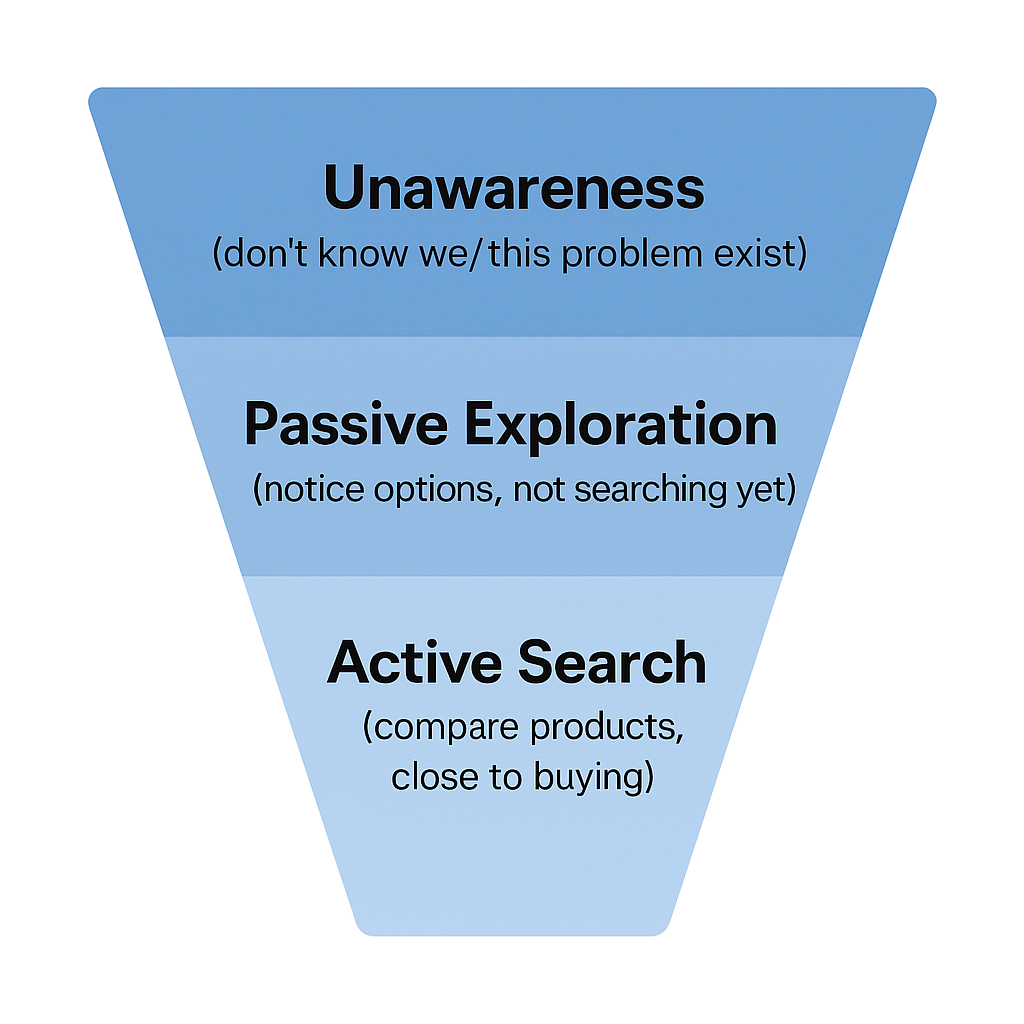
According to Jobs-to-be-Done, people go through several stages in their purchasing journey:
Stage 1, Unawareness. They are unaware that they need a new product. That’s the lowest-intent audience.
Trigger 1. Some events in their life prompt them to start looking for an upgrade and move them to the next stage.
Stage 2, Passive Exploration. At this stage people start noticing relevant ads, doing some initial research, checking out websites.
Trigger 2. Another event in their life pushes them to start actively looking for a solution.
Stage 3, Active Search. These people are usually ready to make a purchase right away if they find a suitable solution. That’s the highest-intent audience.
We can also think of these stages as a funnel:
Defining broad audience
Now, let’s see how I can apply the same funnel to my product.
As a first step, I need to broadly define my target audience overall. If I want my message to resonate, people at stage 1 cannot be everyone (at least, if you’re not Coca-Cola).
My app is most useful to people in leadership positions – managers, team leads, and so on. People who own their time and need a structured approach to daily prioritization. This is a broad enough market with very distinguishable characteristics – chaotic days, a lot of meetings, changing priorities.
So, that’s my stage 1 audience – people in leadership roles.
Narrowing down to high intent
Usually, leaders are a difficult audience to sell to. They have tried many tools, built strong habits, and are very reluctant to change them. To narrow it down to a high-intent audience, I need to catch them at a moment when they are most ready for change.
Based on my personal experience and some user interviews, there are several common triggers:
Stepping into a leadership role. People who have just become managers or team leads, especially for the first time, are most ready to change their behaviour. The nature of their work changes completely. New requirements and stress crush their existing productivity habits. They are ready to try a new tool and are even actively looking for it.
Personal events. A real story from one of the user interviews: “I was working hard at my job. Alongside that, I was finishing my MBA. Everything was under control, but in the middle of it I learned that I was pregnant and realized my simple todo list could no longer cope with that.”
Increased workload. Another variation could be starting a personal project, getting promoted to the next level, or switching careers.
Let’s sum it up
Audience overall – people in leadership roles
High-intent audience:
New leaders or managers
Experienced leaders who go through life-changing personal events (such as becoming a parent)
Leaders who experience an increase in workload – recent promotion, starting a business, and so on
Now, as I’ve identified the high-intent audience, I can start working on ads.
But before I move there, I need to define a couple of attributes that would make my product stand out and resonate with this target audience. These attributes will become the core of my marketing message and offer. To sell high-tier subscriptions, I need to make my product one of a kind, even if it’s a boring todo app. More on this in the next article.

These cats look at you as their target audience.